Table
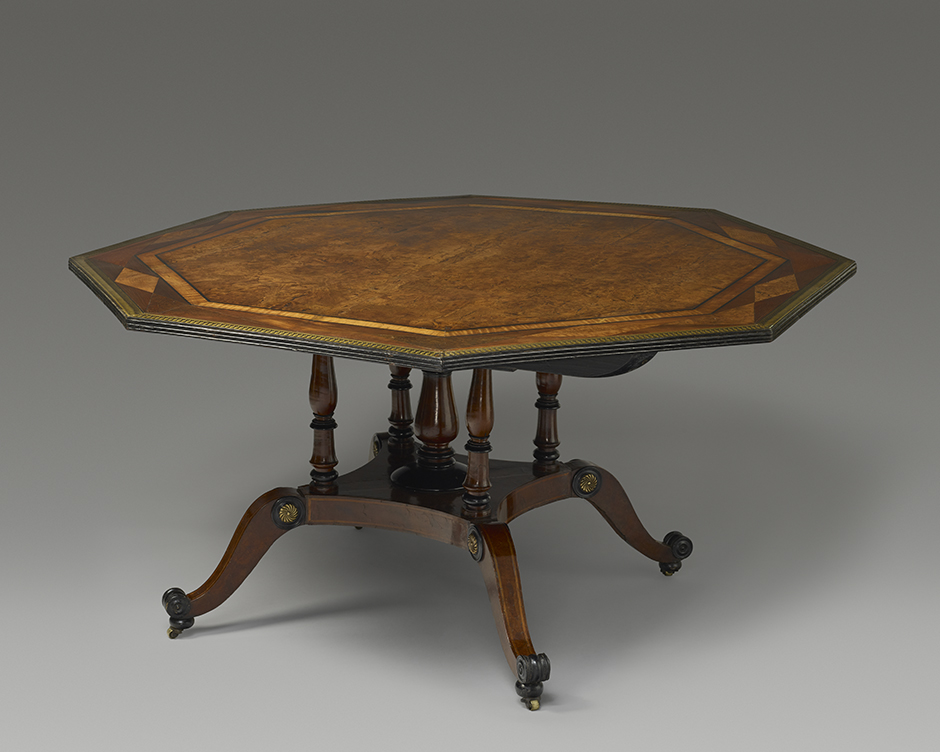
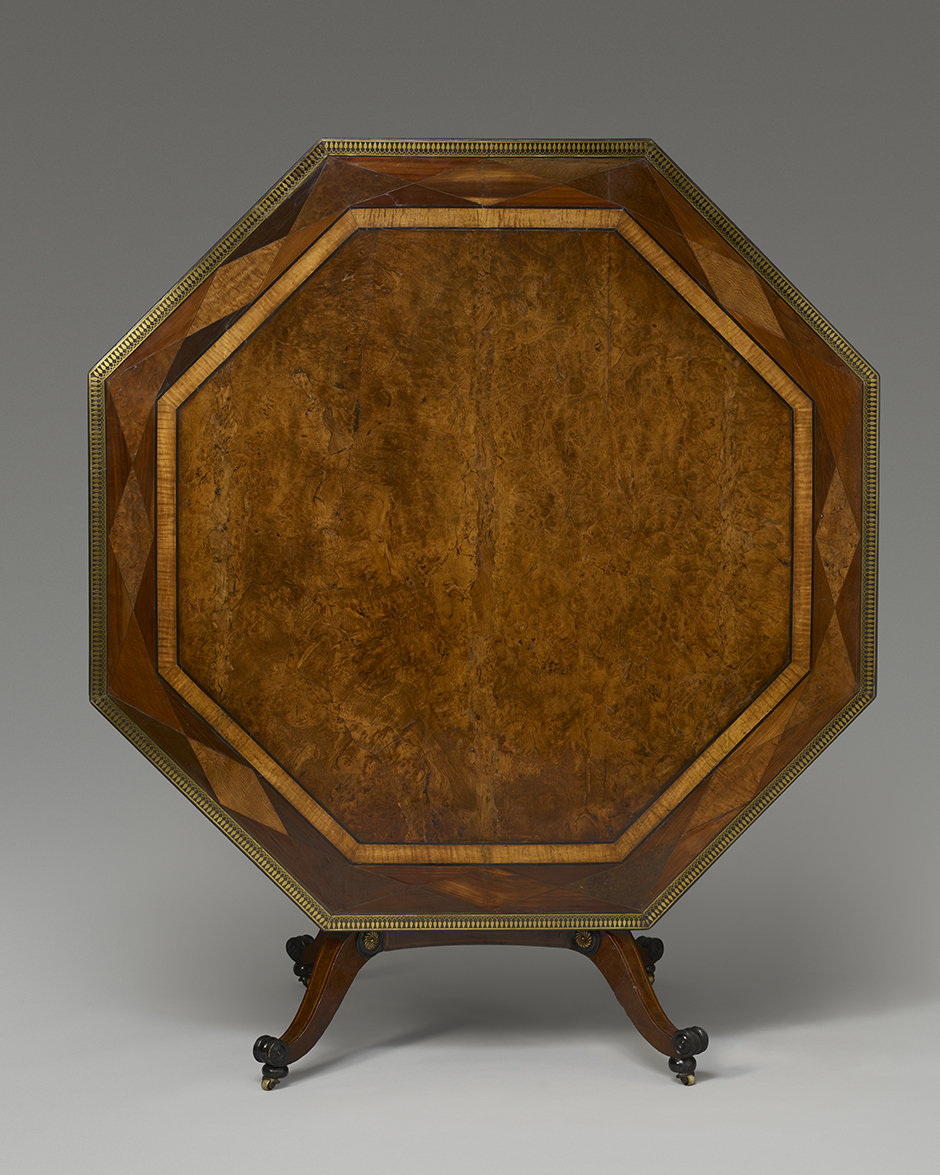


-
Designer / Maker
Designed and manufactured by George Bullock (died 1818)
-
Detail
Burr oak, with specimen wood border and brass inlay
73.5 x 152.5 x 152.5 cm
English (London), circa 1814
-
Provenance
[…]; with Asprey, January 1988; private collection
-
Literature
Martin Levy, A Royal Visit to George Bullock’s Workshop, 1814’, Furniture History Society Newsletter 211, August 2018 (for a table of this form acquired by Queen Charlotte); see below.
Martin Levy, ‘Napoleon in Exile. The Houses and Furniture supplied by the British Government for the Emperor and his Entourage on St Helena’, Furniture History XXIV (1998), Appendix 1, no. 26, fig. 46 (for a table of this form supplied to Napoleon sort his use on St Helena).
-
Notes
A Royal Visit to George Bullock’s Workshop, 1814
With so many aspects of nineteenth-century furniture and interior decoration, it was Clive Wainwright (1942-99) who made connections that encouraged further research; opportunities often generously passed on to others.
In his essay ‘George Bullock and his Circle’[1] Wainwright made two references that indicated links between the British monarchy and the designer and cabinet-maker George Bullock (died 1818). The first was to the ‘express order of the Prince Regent’ for the house and furniture to be used by Napoleon and his entourage in exile on St Helena.[2] The second was to an inkstand formerly in the collection of Queen Charlotte (1744-1818), and Wainwright wondered if she had owned more.[3]
Not only do we now know that the answer to the question is yes, but we may begin to understand better the circumstances. A recently identified report under the heading ‘The Mirror of Fashion’ in The Morning Chronicle, 24 August 1814[4] notes:
‘Yesterday, at about 12 o’clock, her MAJESTY, accompanied by the Princesses ELIZABETH [1770-1840] and MARY [1776-1852], attended by Lady M. WINYARD, went from the Queen’s Palace, in a carriage, to Mr. GEO. BULLOCK’s Mona Marble and Furniture Works, in Tenterden-street, Hanover-square; previous notice having been given of the honour of the intended visit, the Royal party were received in the entrance hall[5] by Mr GEO. BULLOCK, who had the honour of conducting the QUEEN and PRINCESSES through the different apartments of his extensive establishment. Her MAJESTY and PRINCESSES were graciously pleased to express their high approbation. Her MAJESTY and the PRINCESSES selected some of the most choice and beautiful furniture, manufactured of oak and mona marble; and the QUEEN condescended to accept a magnificent table which had been executed purposely for her MAJESTY, of a singularly fine specimen of English oak, surrounded by the choicest foreign woods. The Royal Party afterwards visited the newly erected workshops in Oxford-street,[6]where they inspected the various branches of business carried on in that extensive manufactory, and appeared extremely gratified. Their attention was particularly attracted by the tractability of a deaf and dumb boy employed in the works, who obeyed her MAJESTY’s commands by her signs. The Royal Family left the establishment about half past one o’clock, and returned to the Queen’s palace…’
It can now be shown that the ‘magnificent table which had been executed purposely for her MAJESTY, of a singularly fine specimen of English oak, surrounded by the choicest foreign woods’ is surely the one today in the Duchess of Kent’s Drawing Room at Frogmore House.[7] The top is veneered with oak within a border of lozenge shaped pieces of specimen woods, identified underneath. The specimen veneers are: ‘Bow wood/Africa; Mahogany/Spanish; Rose Wood/South America; Crown Wood/Africa; Nutmeg Wood/Africa; Evergreen Oak/British; Gold Wood/Africa; Evergreen Wood/Africa; Bow Wood/Africa; Topaz Wood/South America; Yew/British; Zebra Wood/America’.[8] The form of ‘Queen Charlotte’s table’ is very similar to a table ordered in 1815 for Napoleon’s use on St Helena.[9]
Also still in the Royal Collection, and probably by George Bullock, are a pair of characteristic rosewood, brass inlaid and marble-topped cabinets[10] and a pair of small side cabinets, the doors of which are inlaid with a brass wreath, crossed with thyrsi.[11] The pattern on the doors is closely related to that on the similarly proportioned cabinet at Abbotsford, manufactured in 1816 by Bullock for Sir Walter Scott’s plaster bust of Shakespeare, also by Bullock.[12]
Unfortunately, Queen Charlotte’s papers are extremely patchy and nothing survives from the period to shed further light on these purchases,[13] if indeed we are safe to assume that they were all hers.
However, one further mystery can now, it would seem, be solved. In 1995 English Heritage acquired for Ranger’s House a ‘dwarf’ cabinet inscribed on its drawer: ‘A British Oak Cabinet presented by Her Majesty to her Royal Highness The Princess Sophia of Gloucester [1773-1844]. August 1814’.[14] The provenance of the cabinet, the manufacture of which was confidently attributed in 1995 to George Bullock, was documented from the auction sale the year after Princess Sophia’s death. Mr Frederick Chinnock, and Messrs Collinson & Hurley, on the premises, 29 January 1845 (and four following days), day three, lot 440, when it was sold from the ‘Centre With-Drawing Room’. In the sale catalogue it was highlighted as ‘A very elaborately designed winged cabinet, formed of a splendid specimen of Pollard Oak, tastefully inlaid with ebony, gilt raised trellis back, china shelf over centre, turned column supports and open brass gallery, four gilt trellis panel doors under, fitted with fluted crimson silk, enclosing nests of oak drawers, lined with cedar, Bramah’s patent locks and keys, a present from Her Late Majesty Queen Charlotte’.[15]
It is reasonable to connect this gift to her niece, with Queen Charlotte’s visit to the Bullock workshop on 24 August 1814, in advance of Princess Sophia’s move into Ranger’s House in 1815.
It has already been noted that ‘A very sumptuous circular ink stand, of the late George Bullock’s Buhl manufacture …[16] was in the sale of The Remaining Part of a Valuable Collection of Curiosities, comprising Carvings in Ivory, Trinkets, Coins, Porcelain and Furniture from the collection of Queen Charlotte. And finally, a payment of £106 11s 7d was made to Bullock on 6 March 1816 for unspecified ‘chimneypieces’, originally ordered in 1814.[17]
Coming so soon after Bullock had become fully established in the London, Royal patronage would have been appreciated as a most encouraging and valuable accolade. Perhaps further evidence of Bullock’s work for the Royal Family will emerge.[18]
[1] In Clive Wainwright, et al., George Bullock: Cabinet Maker, London, 1988, pp. 13-39.
[2] Ibid., pp. 33-37.
[3] Ibid., p. 38-39.
[4] The writer is grateful to Alec Berry for drawing this reference to his attention.
[5] Wainwright, op. cit. (see note 1), fig. 3. Wainwright suggested that this page from the so-called Wilkinson Tracings (City Museums and Art Gallery, Birmingham) might depict Bullock standing on the inner hall staircase at Tenterden Street.
[6] See Martin Levy, ‘George Bullock’s Partnership with Charles Fraser, 1813-1818, and the Stock-in-Trade sale, 1819’, Furniture History XXV (1989), pp. 145-213.
[7] RCIN 27376.
[8] https://www.royalcollection.org.uk/collection/search#/5/collection/27376/tilt-top-table
[9] See Martin Levy, ‘Napoleon in Exile. The Houses and Furniture supplied by the British Government for the Emperor and his Entourage on St Helena’, Furniture History XXIV (1998), Appendix 1, no. 26, fig. 46.
[10] https://www.royalcollection.org.uk/collection/search#/3/collection/73/display-cabinet
[11] https://www.royalcollection.org.uk/collection/search#/4/collection/82/a-pair-of-side-cabinets
[12] Wainwright, et al., op. cit. (see note 1), no. 15.
[13] Letter from Hugh Roberts, 2 March 1995.
[14] See Dalya Alberge, ‘Royal gift comes home after 150 years’, The Times, 11 April 1995.
[15] The provenance was identified by Julius Bryant, at the time a curator with English Heritage.
[16] Christie’s, 24 May 1819, lot 38. For the likely appearance of this inkstand see an example now in the collection of the Museum of Fine Arts, Boston, and illustrated in the exhibition catalogue Splendor and Elegance. European Decorative Arts and Drawings from the Horace Wood Brock Collection, Boston, 2009, cat. no. 66.
[17] National Archives, Kew: 19/44/15. Information first received from Clive Wainwright, March 1992, and confirmed, with further detail, in the letter from Hugh Roberts, 2 March 1995 (see note 13).
[18] The writer is grateful to Rufus Bird for confirming that he has, to date, found no further documentation connecting the Royal family to George Bullock.
As published in Furniture History Society Newsletter, August 2018